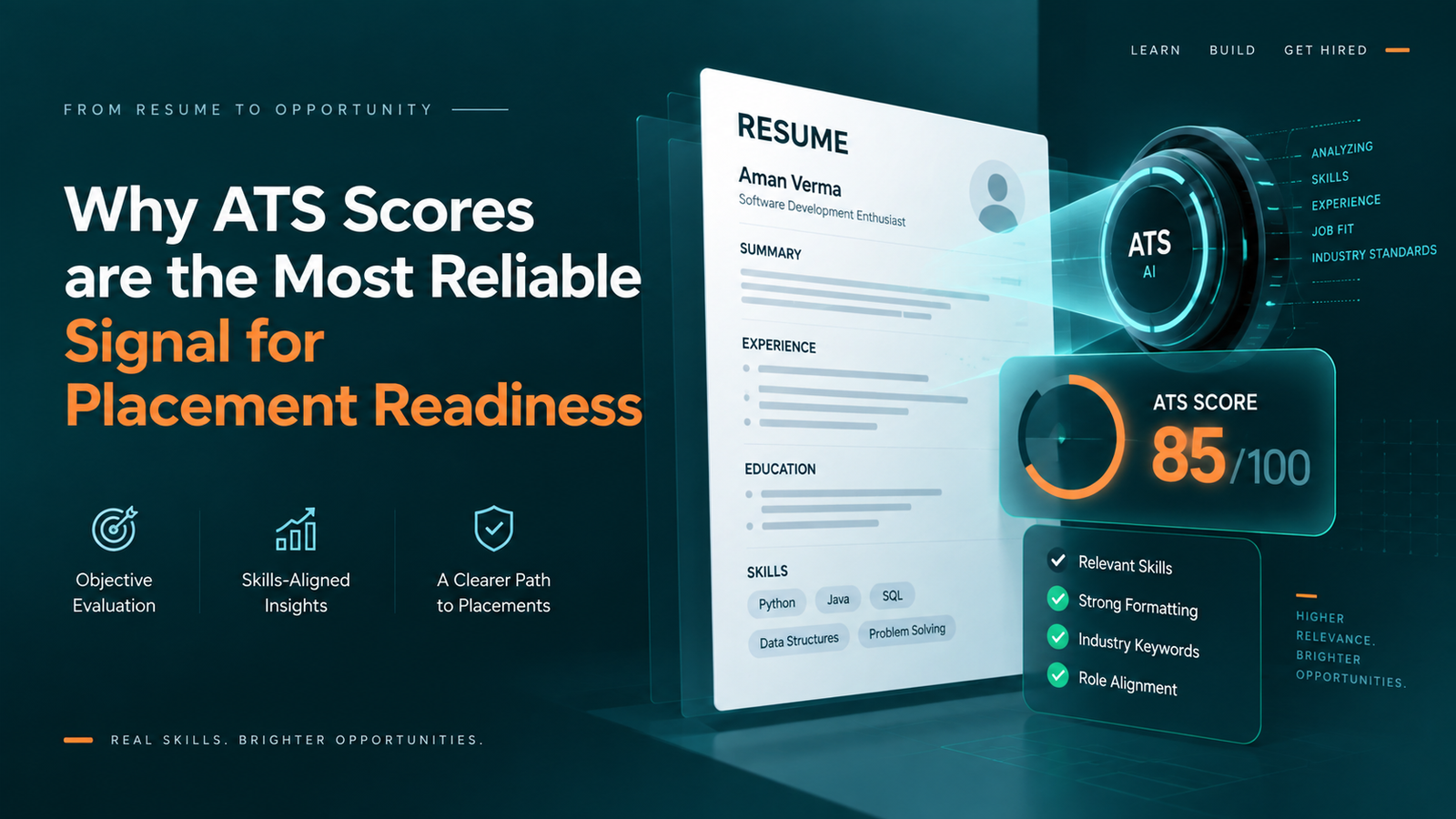
Why ATS Scores are the Most Reliable Signal for Placement Readiness.
Why objective Applicant Tracking System (ATS) scoring provides placement cells with reliable, unbiased benchmarks for campus placement preparation.
 By Shivani S, Co-founder, ReachRole
In corporate campus recruitment and off-campus hiring across India, over 90% of mid-to-large enterprises utilize Applicant Tracking Systems (ATS) — such as Workday, Taleo, Greenhouse, Darwinbox, and Naukri Resdex — to automatically ingest, parse, and filter candidate applications before human recruiters ever review a profile.
A college student with strong technical competence, high academic marks, and solid project experience can be silently rejected in the first stage of recruitment simply because their resume uses multi-column tables, unsupported icon fonts, floating text boxes, or missing technical taxonomy. To an enterprise ATS parser, an unparseable resume appears as blank or garbled text, resulting in immediate mechanical disqualification.
For college placement cells and Training and Placement Officers (TPOs), using objective ATS scoring as an institutional benchmark provides a reliable, scalable, and unbiased framework to ensure students meet enterprise screening requirements before campus placement drives commence.
Why is ATS scoring the most effective metric for college placement readiness?
ATS scoring mirrors the actual automated filtering software used by corporate recruiters. It provides objective, quantitative diagnostic metrics (0–100) on keyword matching, formatting compliance, and section readability, eliminating subjective reviewer bias and enabling rapid student self-correction before placement drives.
Use this guide well
Apply the recommendations to one real target role at a time, then keep only the changes you can support in an interview.
What an ATS score actually measures in campus recruitment
An ATS readiness score is not an assessment of a student's intelligence or academic GPA; it is a precise, multi-dimensional measurement of machine readability, structural integrity, and job keyword alignment:
1. Parse Rate & Structural Fidelity: Can automated parsing algorithms extract the candidate's full name, email, phone number, education, technical skills, and project history in the correct hierarchical sequence without losing text or merging columns?
2. Semantic Keyword & Technology Alignment: Does the resume contain the specific technical terms, programming languages, database names, and frameworks required by visiting employers (e.g. Java, Spring Boot, React, Docker, SQL, REST APIs) rather than generic descriptive prose?
3. Formatting & Typography Compliance: Is the resume structured in a clean, single-column layout without embedded graphics, skill rating bars, tables, or headers and footers that trigger parsing errors?
4. Metric & Impact Density: Do project and internship bullet points follow the proven formula of action verb + technical tool + quantifiable outcome, proving tangible execution rather than passive duty participation?
The 5-dimension ATS scoring rubric for college cohorts
ReachRole evaluates student resumes across five core algorithmic dimensions totaling 100 points:
1. Section Parsing & Structural Integrity (25 Points): Evaluates whether major sections (Education, Experience, Projects, Technical Skills) parse cleanly in standard reverse-chronological order without orphaned text.
2. Role & Industry Keyword Alignment (30 Points): Matches technical vocabulary against real-time industry job descriptions for target engineering and business roles.
3. Quantifiable Bullet Strength & Impact (20 Points): Analyzes bullet points for active engineering verbs, quantifiable metrics (percentages, latency, throughput, scale), and concrete business impact.
4. Technical Proof & Repository Verifiability (15 Points): Checks for live deployed URLs, verified GitHub repositories, and complete documentation links.
5. Layout & Single-Column Formatting Hygiene (10 Points): Confirms zero multi-column traps, tables, graphic icon fonts, or margin contact headers that corrupt enterprise ATS engines.
- Section Parsing & Hierarchy: 25 Points
- Role Keyword Alignment: 30 Points
- Quantified Metric Density: 20 Points
- Technical Proof & Project Links: 15 Points
- Single-Column Formatting Hygiene: 10 Points
Top 5 ATS parsing traps commonly caught across student batches
Analyzing batch scans across thousands of engineering students reveals five repetitive layout and formatting errors that cause automated ATS parsers to fail:
1. Multi-Column Grid Layouts: When a student uses a two-column template (such as skills on the left and experience on the right), ATS parsers scan horizontally across the page, merging unrelated text into an unreadable scramble.
2. Contact Information Trapped in Page Margins: Placing email addresses, phone numbers, or LinkedIn URLs inside MS Word headers or footers causes parsers to miss contact information entirely, creating orphaned applicant profiles.
3. Graphic Skill Rating Bars & Icon Fonts: Replacing textual skill declarations with 5-star rating bars, circular progress charts, or font icons (like envelope or phone icons) results in dropped data layers during text extraction.
4. Non-Standard Section Titles: Using creative headings (such as "What I Bring to the Table" or "My Journey") confuses the parser's section classifier, causing it to miscategorize or ignore entire project histories.
5. Image-Only or Scanned PDFs: Saving a resume as a flattened image PDF prevents text selection, causing automated OCR parsers to register the document as a blank file.
- Trap 1: Multi-column layouts that merge columns horizontally during text extraction.
- Trap 2: Header/footer contact details that get dropped by enterprise parsers.
- Trap 3: Graphic skill bars and rating icons that produce unparseable binary characters.
- Trap 4: Non-standard section headings that fail standard taxonomic categorization.
- Trap 5: Flattened raster image PDFs without selectable text layers.
Subjective faculty reviews vs objective ATS scoring engine
Traditional manual resume verification in universities often relies on subjective visual preferences, leading to inconsistent guidance across departments. An objective scoring engine standardizes evaluation across the entire institution:
| Evaluation Dimension | Subjective Manual / Peer Review | Objective ATS Scoring Engine |
|---|---|---|
| Evaluation Standard | Varies by faculty member's aesthetic preference | Standardized against corporate ATS algorithms (Workday, Taleo, Greenhouse) |
| Error Detection Accuracy | Misses hidden parsing traps like margin text and column merges | Detects 40+ structural parsing errors, text-layer issues & non-standard fonts |
| Keyword Relevance Scoring | Limited by reviewer's individual technical familiarity | Evaluates exact hard-skill match against live industry job descriptions |
| Student Iteration Cycle | Requires scheduling manual in-person review appointments | Instantaneous self-service scanning; student fixes issues in minutes |
| Institutional Analytics | No aggregate tracking; TPOs cannot see batch trends | Centralized dashboard tracking batch readiness, branch gaps, and improvements |
| Scalability | Breaks down completely with cohorts above 100 students | Effortlessly scales to thousands of students with zero marginal effort |
The three-step placement preparation spectrum
Objective ATS scoring forms the foundational first step in a complete institutional placement preparation roadmap:
Step 1 — ATS Compliance & Keyword Alignment (Readiness Score 80+): Ensuring every student's resume passes automated corporate screening filters with clean single-column structure, standard section headings, and high role-specific keyword density.
Step 2 — Proof of Work & Technical Validation: Backing up every resume claim with deployed GitHub repositories, live application URLs, clean documentation, and demonstrable projects.
Step 3 — Technical Articulation & Interview Mastery: Preparing candidates to articulate their engineering decisions, explain system architectures, and navigate behavioral questions with clarity and confidence.
- Step 1: Machine compliance — ensuring the profile survives automated corporate screening filters.
- Step 2: Technical proof — verifying that claimed skills are backed by verifiable code and live demos.
- Step 3: Human communication — mastering technical articulation and interview problem-solving.
Frequently asked questions by TPOs and placement directors
Q1: Do service-based mass recruiters (TCS, Infosys, Wipro, Cognizant) use ATS parsers? Yes. While aptitude tests filter initial eligibility, corporate hiring databases (such as Taleo, Darwinbox, and internal HRMS) index candidate profiles by technical skill keywords to assign project streams and interview panels.
Q2: What is the optimal benchmark score for campus placement eligibility? An ATS score of 75+ ensures the candidate meets standard structural compliance. For premium product company drives (paying 12+ LPA), targeting an 85+ score with verified GitHub deployment links maximizes shortlisting.
Q3: How often should students rescan their resumes? Students should rescan whenever they complete a new project, achieve a hackathon milestone, or tailor their profile for a specific visiting company.
Best practices for colleges implementing an ATS readiness threshold
Top engineering institutions that successfully implement automated ATS scoring follow four key operational guidelines:
1. Establish a Minimum Readiness Gate: Require students to achieve a benchmark score (e.g. 75+ or 80+) before their profiles are submitted to visiting premium recruiters, guaranteeing high shortlisting rates.
2. Early Pre-Final Year Onboarding: Introduce ATS scoring during the 5th and 6th semesters so students have ample time to identify missing project areas, take targeted upskilling courses, and refine their resumes before final-year drives begin.
3. Departmental Skill Deficit Analysis: Use cohort reporting to identify systemic branch weaknesses—such as circuit branches needing more full-stack projects or core branches needing CAD/simulation keywords—and organize focused faculty bootcamps.
4. Track Semester-on-Semester Growth: Monitor batch improvement scores over time to demonstrate measurable placement readiness gains to university leadership and accreditation bodies.
Implement ATS readiness tracking with ReachRole for Colleges
ReachRole for Colleges provides placement cells, TPOs, and university directors with real-time cohort tracking, batch ATS score distributions, and instant student diagnostic feedback through a secure partner dashboard.
Students maintain complete privacy and control over their individual profiles while placement officers gain high-level visibility to drive institutional placement success.
Check your resume against these hiring standards
Upload your PDF to get an instant match score, detect missing keywords for your target role, and check single-column parsing.
Scan my resume free → ✓ No account needed · Takes 60 seconds
Shivani S Co-founder, ReachRole
Co-founder of ReachRole. Writes about ATS screening, resume structure, and the Indian hiring process.