Bridging the Employability Gap: Graduate Readiness in 2026.
How engineering colleges can bridge the gap between academic curriculum and industry hiring using proof of work, verified portfolios, and ATS alignment.
 By Shivani S, Co-founder, ReachRole
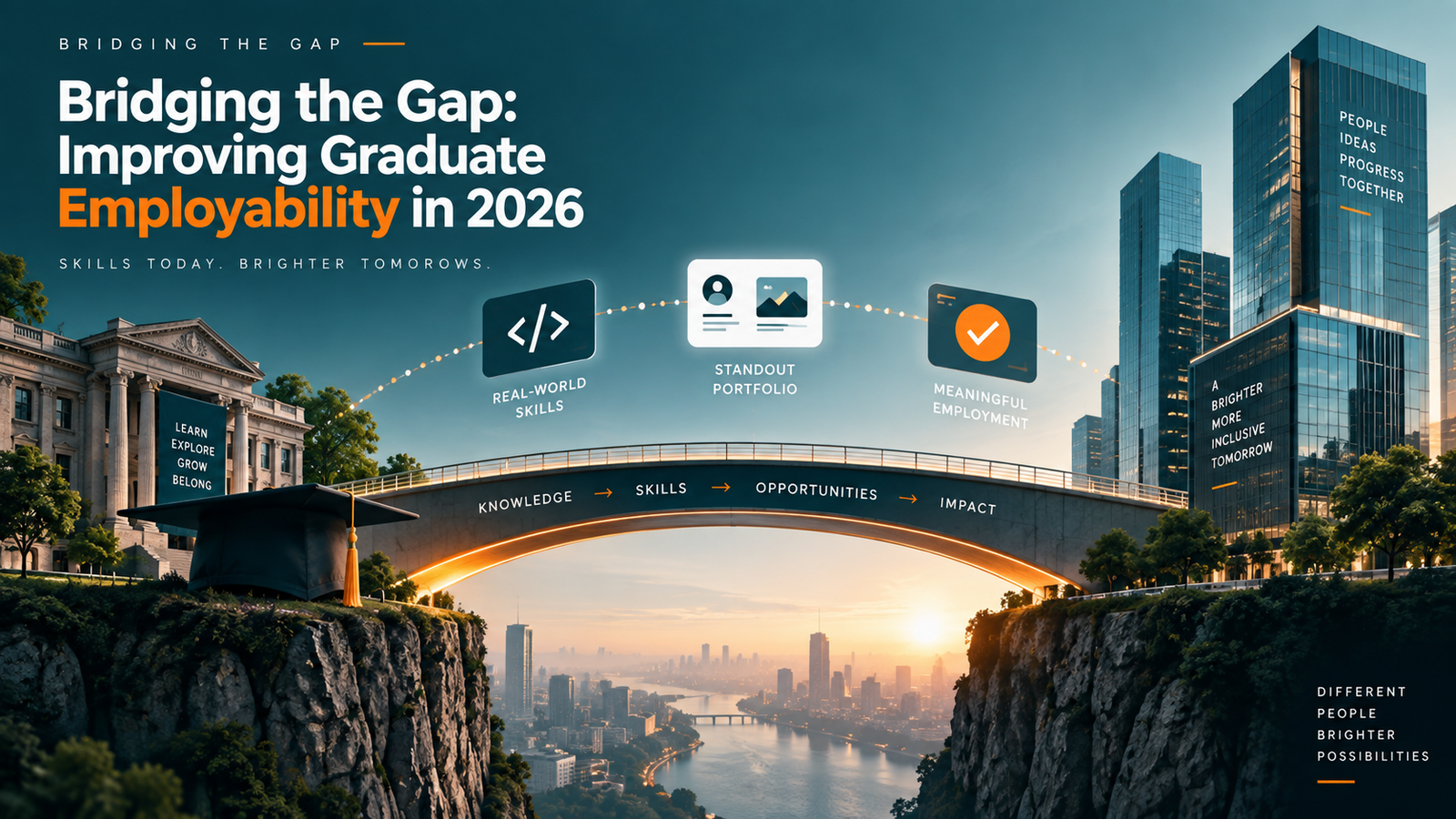
The traditional degree-to-job pipeline has fundamentally transformed across the Indian technology hiring landscape. In 2026, possessing an engineering degree or a high CGPA serves merely as a baseline eligibility filter; actual hiring decisions at top product firms, Global Capability Centers (GCCs), and high-growth tech startups are driven by verifiable proof of work and role-specific technical capability.
Every year, Indian engineering universities graduate over 1.5 million students. Yet, corporate recruiters consistently report that less than 20% of fresh graduates are immediately deployable into software development and engineering workflows without extensive corporate training. This "employability gap" is rarely a deficit of theoretical intelligence. Rather, it is an execution gap: students who understand algorithmic theory on paper but have never deployed an application, structured a clean Git repository, handled API error states, or optimized a resume for enterprise ATS parsers.
Bridging this gap requires a deliberate shift in how colleges and students approach campus placement preparation. By replacing generic academic assignments with production-grade portfolios, objective ATS benchmarking, and structured interview articulation, institutions can dramatically lift student shortlisting and starting compensation.
How can fresh engineering graduates demonstrate industry employability in 2026?
Graduates must move beyond GPA to demonstrate tangible Proof of Work. Modern tech hiring prioritizes candidates with production-deployed GitHub projects, clean live demo links, single-column ATS-compliant resumes tailored to target tech stacks, and the ability to articulate technical trade-offs in structured STAR-format interviews.
Use this guide well
Apply the recommendations to one real target role at a time, then keep only the changes you can support in an interview.
The shifting hiring paradigm: From credentials to verifiable proof of work
For decades, campus recruitment relied on standardized academic cutoffs (e.g. 70%+ throughout 10th, 12th, and B.Tech) followed by basic aptitude testing. Today, leading technology employers have reduced reliance on academic cutoff percentages in favor of objective capability signals:
Academic Knowledge Claim: "I completed a course on Database Management Systems and know SQL syntax."
Verifiable Proof of Work: "I architected an indexed PostgreSQL database handling 10,000 concurrent writes with query latency under 45ms, documented on GitHub with schema migrations, Docker configuration, and load test scripts."
The candidate who provides verifiable technical proof consistently outranks candidates with higher academic scores but empty project portfolios. Corporate recruiters want to see evidence that a student can read documentation, write maintainable code, test edge cases, and collaborate using modern developer tooling.
Academic projects vs industry-ready developer portfolios
One of the primary reasons fresher resumes get discarded during technical screening is reliance on generic "tutorial clones". Recruiters review dozens of identical to-do apps, basic weather widgets, or standard calculator assignments. The difference between an academic submission and an industry-grade portfolio is profound:
| Project Dimension | Generic Academic Assignment | Industry-Ready Developer Portfolio |
|---|---|---|
| Project Originality | Copied directly from YouTube tutorials or textbook samples | Solves a real-world problem with custom business logic |
| Deployment & Hosting | Runs only locally on localhost:3000 | Deployed live on Vercel, Render, AWS, or Docker with working URL |
| Code Quality & Architecture | Single monolithic file without modular organization | Clean directory structure, separation of concerns, environment variables |
| Testing & Validation | Zero tests; fails on basic null or empty inputs | Unit and integration tests with automated CI/CD pipeline |
| Repository Documentation | Default or empty README file | Comprehensive README with architecture diagram, setup steps, and API docs |
| Interview Defensibility | Student cannot explain why specific libraries were chosen | Student articulates architectural tradeoffs, scaling limits, and bottlenecks |
The three pillars of 2026 graduate employability
To achieve top-tier placement shortlists, college students must cultivate three core structural pillars throughout their pre-final and final years:
Pillar 1: Production-Grade Proof of Work: Every student should build and deploy at least two substantial domain-specific projects. For full-stack developers, this means authenticating users, managing state, and handling asynchronous background jobs. For data engineers, it means building automated data pipelines with real datasets. For mobile developers, it means publishing a functional app to GitHub with clear demo videos.
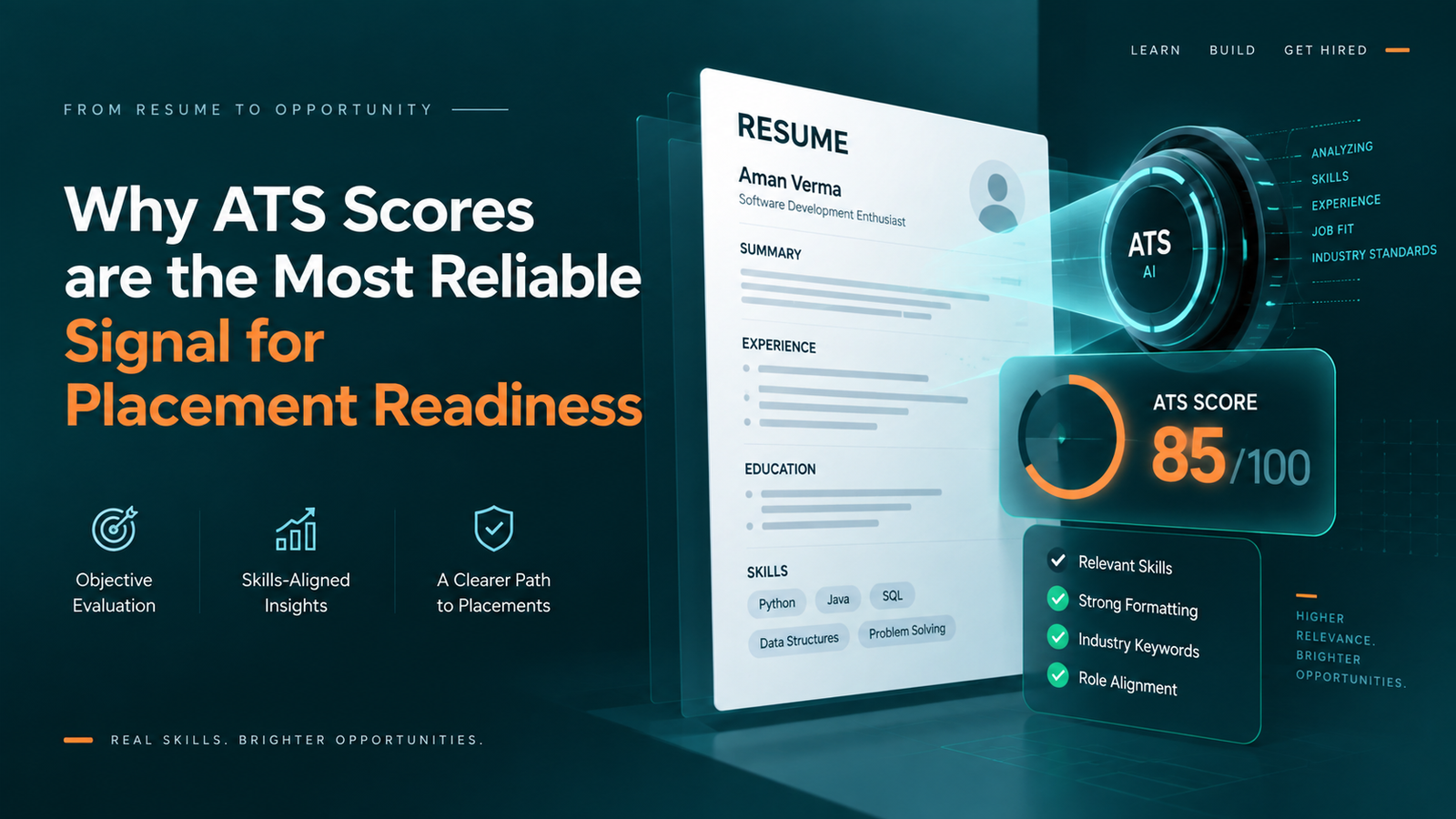
Pillar 2: ATS Keyword & Format Compliance: A brilliant project portfolio is useless if the student's resume fails initial automated parser screening. Students must format their resumes using clean single-column layouts, standard section headings (Technical Skills, Experience, Projects, Education), and exact industry keywords (e.g. TypeScript, Docker, PostgreSQL, REST APIs) rather than vague duty descriptions.
Pillar 3: Technical Articulation & Interview Mastery: Candidates must be prepared to articulate their engineering decisions using the STAR framework (Situation, Task, Action, Result). Interviewers frequently ask: "What was the most challenging bug you encountered in this project?", "Why did you choose PostgreSQL over MongoDB?", or "How would your system handle 100x traffic?" Being able to discuss trade-offs with confidence separates hired candidates from the crowd.
- Pillar 1: Deployed, original projects with live demo URLs and clean GitHub repositories.
- Pillar 2: Single-column, ATS-compliant resumes with verified keyword density and metric-backed bullets.
- Pillar 3: Structured technical communication and the ability to defend architectural choices under pressure.
Branch-wise roadmap: Breaking into tech from Circuit and Core branches
Students in Electronics (ECE), Electrical (EEE), Mechanical, and Civil engineering often feel disadvantaged during software placement drives. However, tech recruiters actively hire non-CS students who demonstrate solid programming fundamentals and domain specialization:
Electronics & Communication (ECE / EEE): Focus on Embedded Systems, IoT, Firmware Development (C/C++, FreeRTOS, ESP32, MQTT), or Full-Stack Web Development. Highlight the intersection of hardware interfacing and backend API communication.
Mechanical & Civil Engineering: Leverage computational modeling, Python automation, CAD scripting, or Data Analytics. Highlight numerical simulation, optimization algorithms, and data visualization tools (Pandas, SQL, PowerBI, Tableau).
Cross-Branch Strategy: Ensure your resume headline explicitly states your target technical role (e.g. "Software Development Engineer | Java, Spring Boot, PostgreSQL") rather than just your branch degree, ensuring ATS parsers index you correctly.
The 6-step project engineering checklist for fresher resumes
When recruiters review student GitHub repositories and project descriptions, they evaluate software engineering maturity against six foundational criteria:
1. Modern Interface & State Architecture: Clean, responsive user experience built with modern frameworks (React, Next.js, Flutter) with robust client-side validation and state management.
2. Secure Backend API & Authentication: RESTful or GraphQL endpoints incorporating secure authentication (JWT, OAuth), role-based authorization, and rate-limiting middleware.
3. Database Schema & Query Optimization: Relational (PostgreSQL, MySQL) or document (MongoDB) databases featuring proper foreign keys, schema normalization, indexing, and connection pooling.
4. Cloud Deployment & Public Access: Production hosting on platforms like Vercel, Render, AWS (EC2/S3), or Docker containers with live accessible URLs.
5. Automated Testing & CI/CD: Unit test coverage using frameworks like Jest, PyTest, or JUnit, automated via GitHub Actions on pull requests.
6. Documentation & Observability: Comprehensive repository README files containing architecture diagrams, setup instructions, sample API payloads, and basic error logging.
- Step 1: Responsive UI with clean client-side validation and state management.
- Step 2: Authenticated backend API with structured error handling and rate-limiting.
- Step 3: Normalized database schema with indexed queries and migrations.
- Step 4: Live deployment on cloud infrastructure with verifiable demo links.
- Step 5: Automated test suite running in GitHub Actions CI pipelines.
- Step 6: Clear technical README documenting architecture and API contracts.
Campus placement myths vs 2026 tech hiring realities
Navigating campus recruitment requires dispelling outdated placement assumptions that mislead students:
Myth 1: "Collecting dozens of online course certificates guarantees interview shortlists." Reality: Recruiters view generic certificates as passive consumption; original, deployed code repositories consistently outperform certificates in hiring decisions.
Myth 2: "Service-based mass recruiters do not screen for project depth." Reality: National Qualifier Tests and differential hiring tracks (like TCS Digital / Prime, Infosys Specialist Programmer, and Wipro Turbo) evaluate advanced system projects and algorithmic problem-solving.
Myth 3: "A two-column graphic Canva resume stands out to corporate HR." Reality: Graphic templates with tables, skill bars, and multiple columns scramble automated ATS parsers, causing silent machine disqualification.
How placement cells can systematically lift batch employability
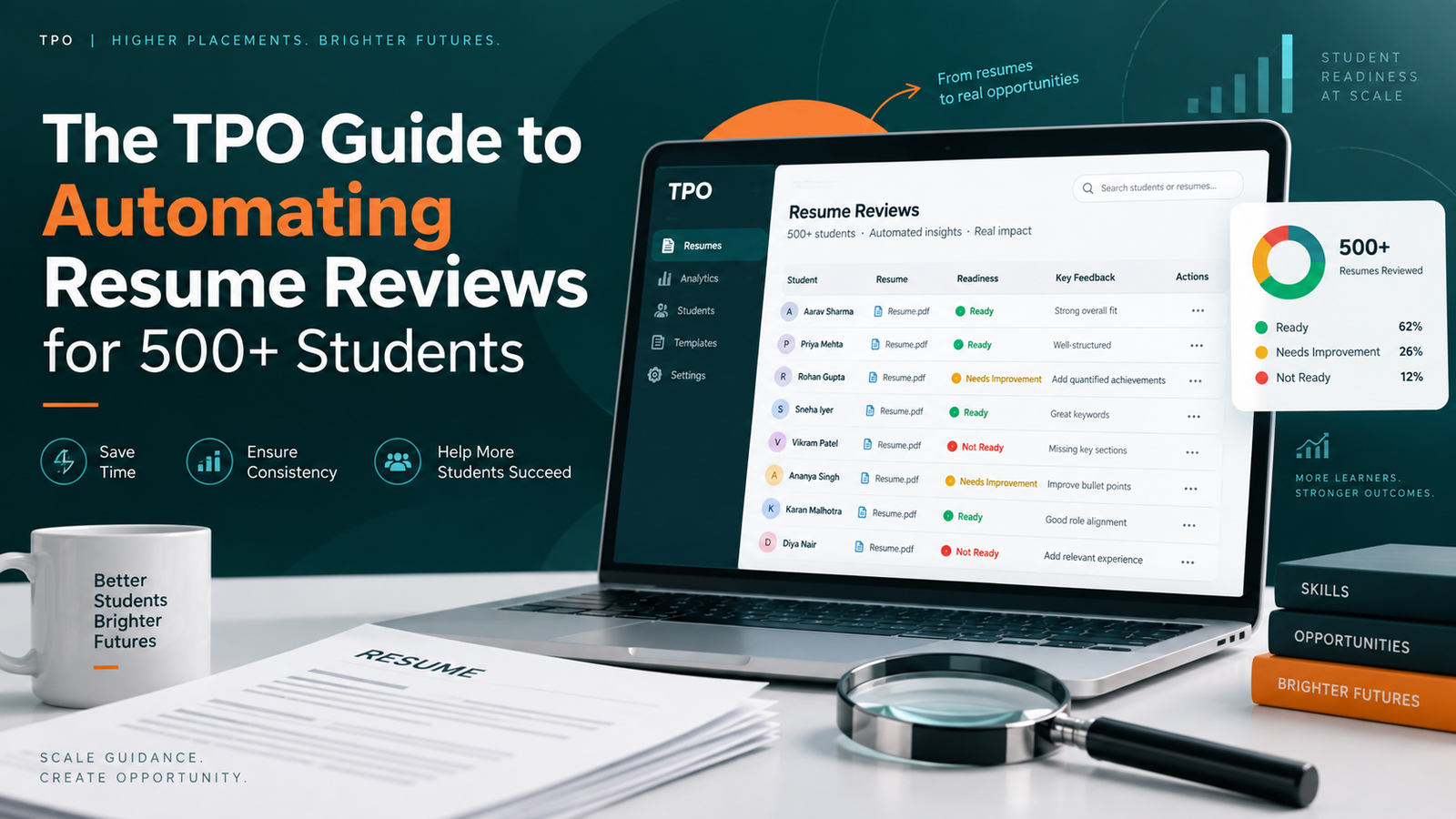
Individual 1-on-1 resume reviews cannot scale across an entire graduating class of 500 to 2,000 students. Forward-thinking engineering institutions use centralized readiness platforms to scale employability across the entire cohort:
1. Pre-Drive Skill Diagnostics: Run aggregate batch scans to identify missing technical competencies across departments before corporate registration opens.
2. Standardized Resume Guidelines: Provide students with proven, ATS-tested templates that eliminate formatting errors and parser rejections across service and product recruiters.
3. Continuous Milestone Tracking: Track student progress across semesters, celebrating students who achieve 80+ readiness scores and providing focused workshops for those below benchmarks.
Equip your institution with ReachRole for Colleges
ReachRole provides colleges and universities with enterprise placement analytics, self-service ATS diagnostics for students, and centralized readiness dashboards for TPOs. By empowering students to self-correct their resumes in real time, placement cells save hundreds of administrative hours while dramatically increasing campus placement shortlisting rates.
Check your resume against these hiring standards
Upload your PDF to get an instant match score, detect missing keywords for your target role, and check single-column parsing.
Scan my resume free → ✓ No account needed · Takes 60 seconds
Shivani S Co-founder, ReachRole
Co-founder of ReachRole. Writes about ATS screening, resume structure, and the Indian hiring process.