The TPO Guide to Automating Resume Reviews for 500+ Students.
Stop manually reviewing hundreds of resumes. How TPOs use ATS scoring and cohort readiness dashboards to streamline campus placement preparation.
 By Shivani S, Co-founder, ReachRole
For most Training and Placement Officers (TPOs) and college placement teams in India, the start of placement season brings an overwhelming operational bottleneck: hundreds of student resumes arriving in email inboxes and Google Drives, waiting for manual review. In an engineering college with 600 to 1,500 final-year students, conducting three iterative rounds of resume feedback means reviewing between 1,800 and 4,500 documents in under eight weeks.
Manually reviewing 500+ resumes with detailed, actionable feedback is mathematically impossible for a standard placement cell to execute consistently. When faculty coordinators and placement teams rely on manual resume checking, severe review fatigue sets in. The first 50 resumes receive careful scrutiny, while the remaining 450 get superficial glance-overs. More critically, students do not learn why their formatting or keyword density failed, repeating the same structural mistakes across on-campus and off-campus drives.
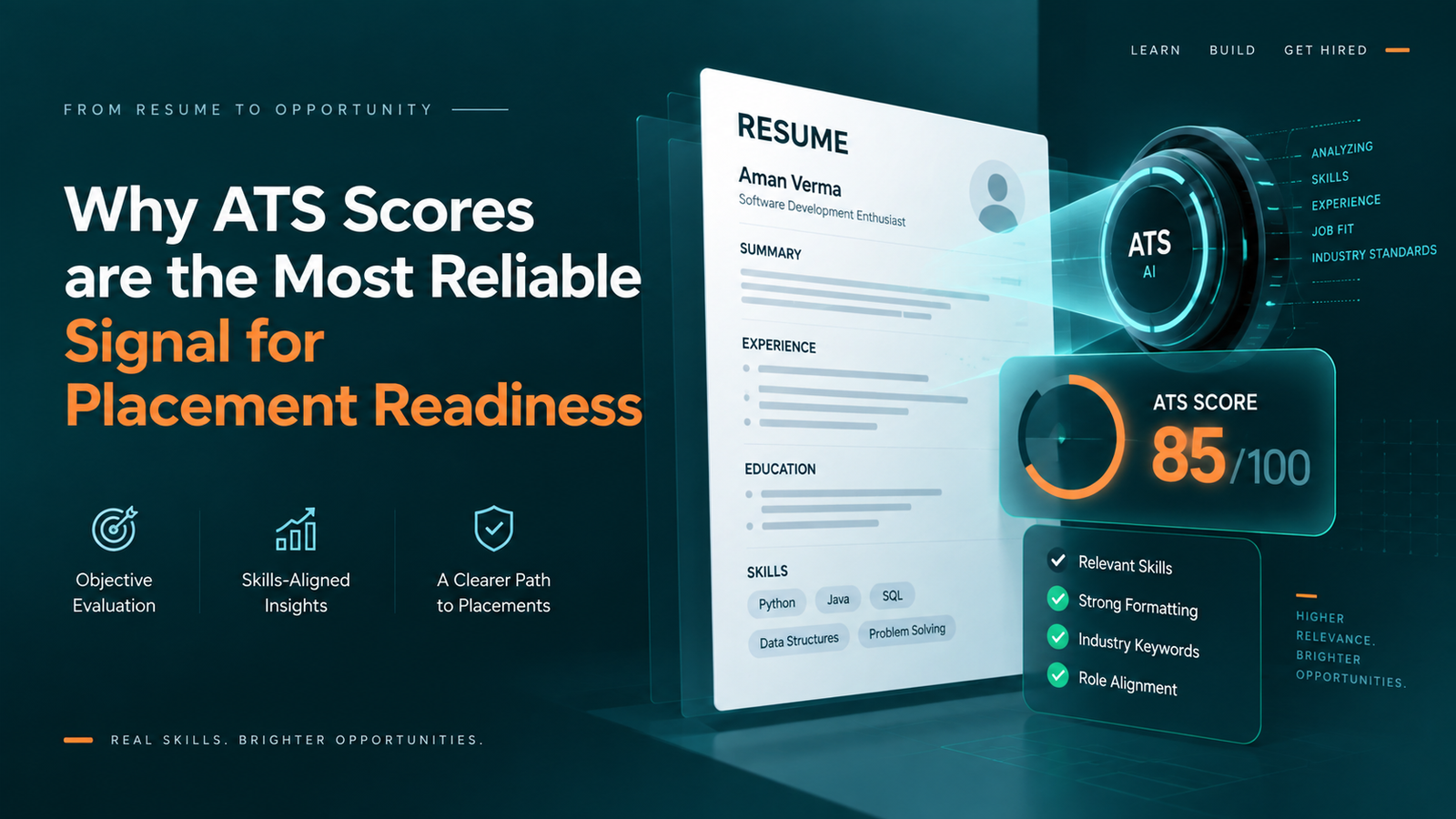
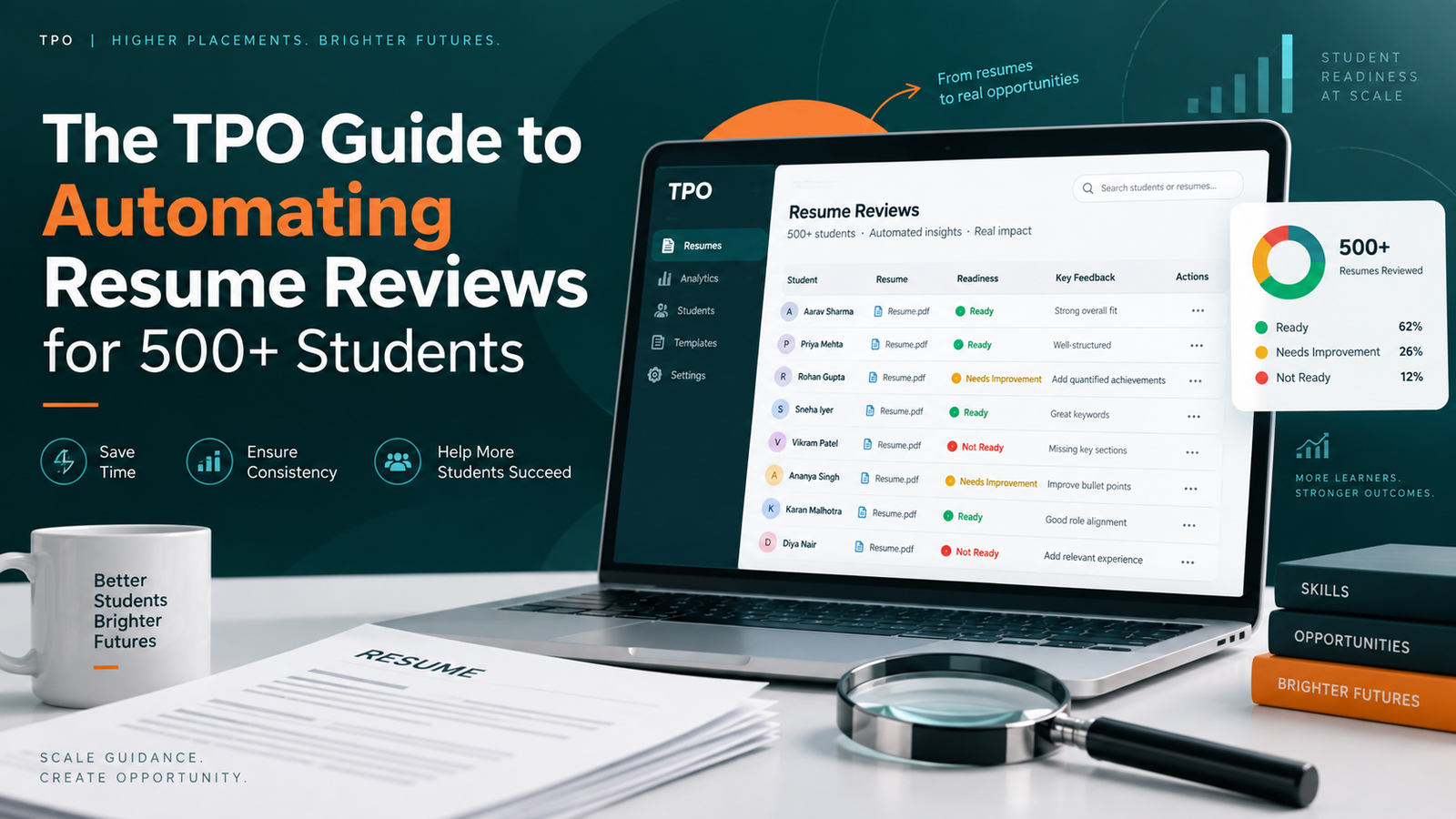
Automating initial resume readiness screening with objective ATS scoring shifts the placement cell from an administrative proofreader to a high-impact strategic coaching body. By establishing standardized benchmarks, placement officers can instantly identify batch-wide skill gaps, group students by preparation readiness, and ensure every candidate submitted to visiting recruiters meets enterprise screening standards.
How can placement cells automate resume reviews for large student batches?
TPOs can replace manual PDF reviews with automated ATS scoring and cohort dashboards. By establishing quantitative readiness benchmarks (0–100), students receive instant feedback on missing keywords, formatting errors, and project gaps to self-correct before drives, while placement teams focus on strategic corporate outreach and interview preparation.
Use this guide well
Apply the recommendations to one real target role at a time, then keep only the changes you can support in an interview.
The three systemic breakdowns of manual placement screening
Manual resume verification across large engineering batches breaks down across three critical operational vectors that directly damage institutional placement conversion rates:
1. Inconsistent Review Quality: Subjective feedback varies wildly between faculty members, departmental coordinators, and student volunteers. What one reviewer considers an attractive modern layout (such as two-column Canva templates or graphic skill rating bars), an enterprise ATS parser like Workday, Taleo, or Darwinbox rejects completely. Students receive conflicting advice that confuses their preparation.
2. Feedback Latency: When a placement cell takes two to three weeks to return marked-up PDFs, students miss early off-campus hiring drives, hackathon registrations, and fast-moving recruitment windows. By the time a student learns their resume has missing technical keywords, visiting recruiters have already finalized candidate shortlists.
3. Invisible Cohort Deficiencies: Without centralized analytics, placement directors cannot identify aggregate curriculum or technical blindspots. If 65% of mechanical engineering students lack basic Python or CAD simulation project keywords, the placement cell discovers this gap only after the company conducts initial screening and rejects the entire batch.
Manual review vs automated ATS readiness pipeline
Modern placement cells in top-tier institutions are transitioning from ad-hoc manual proofreading to automated pre-drive readiness pipelines. The operational contrast is stark:
| Operational Dimension | Traditional Manual Review | Automated ATS Readiness Platform |
|---|---|---|
| Review Speed per Resume | 15–25 minutes of manual faculty time | Instantaneous (under 10 seconds) |
| Error & Parsing Detection | Subjective visual glance; misses hidden parser bugs | Checks 40+ parsing rules, column logic & ATS compatibility |
| Keyword & Role Alignment | Limited by reviewer's personal domain knowledge | Scores against live job descriptions across 50+ tech roles |
| Feedback Loop & Turnaround | 2–3 weeks turnaround per student revision | Immediate self-serve diagnostics; student fixes & rescans in minutes |
| Batch & Cohort Analytics | Zero visibility; data trapped in disconnected spreadsheets | Real-time TPO dashboard tracking branch-wise score distributions |
| Faculty Resource Allocation | 80% time spent fixing commas and font sizes | 100% time spent on company outreach & high-value mock interviews |
The four-tier student readiness framework for TPOs
To manage large candidate pools effectively, placement officers should categorize students into four actionable preparation tiers based on quantitative ATS readiness scores before campus recruitment drives commence:
Tier 1: Placement-Ready (ATS Score 80–100): Students whose resumes demonstrate clean single-column structure, high role keyword density, verifiable GitHub or live deployment links, and metric-backed project bullet points. These candidates are immediately cleared for premium Tier-1 product and consulting company shortlists.
Tier 2: Optimization Needed (ATS Score 65–79): Candidates with strong underlying technical foundations who suffer from formatting errors, weak action verbs, or missing domain terminology. A single automated self-correction cycle allows them to reach Tier 1 status without consuming faculty time.
Tier 3: Critical Deficiencies (ATS Score 50–64): Students with incomplete project descriptions, generic duty-based bullets, or severe parsing traps (such as multi-column layouts or tables). These students require targeted departmental workshops on project documentation and technical articulation.
Tier 4: High-Risk / Unsubmitted (ATS Score < 50): Students who have not initiated placement preparation or whose resumes fail fundamental machine parsing. Automated dashboard visibility flags these students 8 to 12 weeks before placement drives, enabling early remedial intervention.
- Tier 1 (80–100): Direct clearance for premium enterprise campus recruitment drives.
- Tier 2 (65–79): Self-serve keyword and formatting refinement via automated diagnostic reports.
- Tier 3 (50–64): Branch-level group mentoring on technical proof of work and project impact.
- Tier 4 (< 50): Mandatory 1-on-1 counseling and basic foundational formatting intervention.
Transforming student project bullets: Before vs after examples
The single biggest reason qualified college graduates fail automated corporate screening is writing task-oriented bullets instead of impact-driven technical outcomes. Training placement coordinators to teach the Action Verb + Technical Stack + Quantifiable Metric formula transforms student conversion:
Full-Stack Web Development Project: Weak bullet: "Created an e-commerce website using React and Node.js with database integration." Strong bullet: "Architected a full-stack e-commerce web application with React, Node.js, and PostgreSQL; implemented Redis caching and JWT authentication, reducing API response latency by 35% across 500+ simulated users."
Machine Learning / Data Project: Weak bullet: "Worked on Python project to predict house prices using machine learning algorithms." Strong bullet: "Built an end-to-end price prediction pipeline with Python, Scikit-learn, and XGBoost; optimized feature engineering across 15,000 records to achieve 92% R² accuracy, deployed via FastAPI on Docker."
Core / Circuit Engineering Project: Weak bullet: "Assisted in circuit design and microcontroller programming for college lab." Strong bullet: "Designed and simulated an IoT environmental sensor node using ESP32 and MQTT protocol; reduced power consumption by 28% through deep-sleep firmware optimization in Embedded C."
The 5-stage placement readiness calendar for engineering colleges
Implementing a structured readiness roadmap across the pre-final and final year ensures maximum student placement velocity:
Stage 1 (June–July | Pre-Season Baseline Audit): Students upload their initial resume drafts to the institutional portal. The platform automatically benchmarks the entire batch, generating a baseline readiness report for department heads and the placement director.
Stage 2 (August | Automated Self-Correction & Skill Bootcamps): Students receive instant section-by-section diagnostic feedback to fix formatting, align keywords for target roles, and add missing GitHub links. TPOs organize targeted technical workshops for identified batch weaknesses.
Stage 3 (September–October | Readiness Gating & Pre-Drive Verification): The placement cell establishes minimum threshold gates (e.g. 75+ ATS score) for company application eligibility, guaranteeing that every candidate presented to visiting recruiters meets corporate standards.
Stage 4 (November–December | Role-Specific Tailoring): As specific companies announce drive eligibility, students use AI keyword analysis to tailor their project emphasis to the exact job description (e.g. Cloud Backend vs Data Engineering vs QA Automation).
Stage 5 (January–April | Post-Drive Analytics & Remedial Tracking): Unplaced students from earlier drives are automatically grouped into specialized upskilling tracks with refreshed project roadmaps and interview preparation sprints.
Amplifying the placement team with ReachRole for Colleges
ReachRole for Colleges provides engineering institutions, universities, and placement cells with a private institutional portal, centralized cohort dashboards, and automated ATS diagnostic tooling. Students maintain complete privacy over their individual profiles while placement officers gain real-time visibility into batch preparation, branch score distributions, and corporate readiness trends.
Institutions using ReachRole eliminate hundreds of hours of manual administrative proofreading, empowering placement teams to focus their energy on building corporate recruiter relationships and conducting high-impact mock interviews.
Check your resume against these hiring standards
Upload your PDF to get an instant match score, detect missing keywords for your target role, and check single-column parsing.
Scan my resume free → ✓ No account needed · Takes 60 seconds
Shivani S Co-founder, ReachRole
Co-founder of ReachRole. Writes about ATS screening, resume structure, and the Indian hiring process.