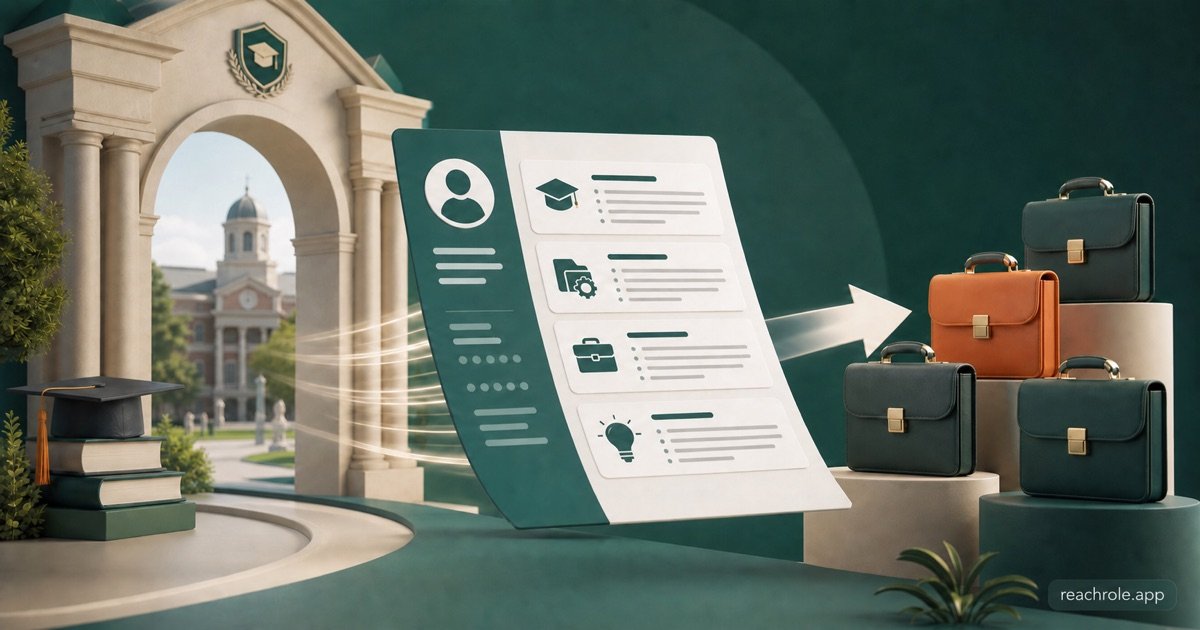
Infosys Resume Format for Freshers (2026 Guide).
How to build an ATS-friendly fresher resume for Infosys drives: project formatting, certifications, and screening checks that decide shortlist calls.
 By Shivani S, Co-founder, ReachRole

What is the best Infosys resume format for freshers?
An ATS-compliant Infosys fresher resume must use a single-column layout with contact details in the document body (never in headers/footers) to prevent parsing errors. Highlight verifiable self-learning credentials (such as Infosys Springboard or NPTEL certifications with completion years) and 2 concrete database-backed projects with live repository links.
Infosys hires freshers at a scale that makes individual resume review impossible in the first pass. Your resume is parsed, your form data is matched against it, and only then does a human read anything. That order is the whole game: a resume that reads beautifully but parses badly never gets to the human stage.
This guide covers what to put on an Infosys fresher resume and how to structure it. For the hiring process itself — eligibility, test pattern, cutoffs — read the official posting you are applying to. Those details change between cycles and every year someone prepares against last year's rules.
Also applying to Wipro or Accenture? The shared basics across all three are in our Infosys, Wipro and Accenture resume guide — one resume, prepped once, works for all three drives.
Structure that survives the first pass
One page. Single column. No header or footer.
That last one costs more freshers than anything else. Contact details placed in a document header are routinely dropped by parsers, which produces a candidate record with no phone number. You are not rejected; you are simply uncontactable.
Order the sections the way the screening expects to find them:
- Contact block in the body of the document, not the header — name, phone, email, city, GitHub or portfolio link
- Education with exact percentages or CGPA, exactly as they appear on your marksheets
- Technical skills grouped by type, using the names the job posting uses
- Projects with technologies named and outcomes stated
- Certifications with the issuing body and year
- Achievements only if they are specific
Learning signals matter more here than elsewhere
Infosys screening responds well to evidence that you teach yourself. That is the practical reason certifications carry weight — not because a certificate proves competence, but because completing one unprompted signals you will get through their training program without hand-holding.
Infosys Springboard courses, NPTEL, and recognised platform certificates all serve this purpose. List them with the issuing body and the year:
The weak version is unverifiable and reads as padding. The strong version can be checked, which is exactly why it is worth more.
Projects are the whole resume for a fresher
You have no professional experience and nobody expects you to. What separates you from the several thousand applications alongside yours is whether your projects are real.
A project entry needs three things: what it does, what you built it with, and something concrete about the result. A GitHub link or a deployed URL turns a claim into a fact.
The second version gives an interviewer three things to ask about, and you can answer all three because you built it. That is the point of a fresher resume: it is the question paper for your own interview, so put things on it you want to be asked about.
The consistency check nobody warns you about
Your resume, your application form, and your documents must agree exactly. Not approximately — exactly.
- Percentage on the resume matches the marksheet, including the decimal
- Name matches your official documents, in the same order
- Graduation year matches everywhere it appears
- Gaps, backlogs, and year drops are stated rather than left to be discovered
Discrepancies get treated as integrity issues rather than typos, and that is not a conversation you recover from in an HR round. A rounded percentage is a rounded percentage; write 72.4 if that is what the marksheet says.
Skills you can defend
Write down only what you can be questioned on. The fastest way to lose an interview is a skills line listing eight technologies where you can only discuss two.
If you used a technology in exactly one project and would struggle to explain it beyond that, either strengthen the project or drop the skill. "Familiar with" is not a category the screening understands, and it is not a category an interviewer respects.
Before you upload
Run the resume through our free ATS resume checker for freshers before submitting it to the portal. Most fresher resumes that get no response are not weak on content — they are unreadable to the software that reads them first, because the contact details sit in a header or the layout is two columns. Our guide on why most resumes never reach a human covers the failure modes in detail.
Keep a copy of the exact file you submitted. Drives can run months apart, and the interviewer reads from the version you uploaded, not the version you improved afterwards.
Check your resume against these hiring standards
Upload your PDF to get an instant match score, detect missing keywords for your target role, and check single-column parsing.
Scan my resume free → ✓ No account needed · Takes 60 seconds
Shivani S Co-founder, ReachRole
Co-founder of ReachRole. Writes about ATS screening, resume structure, and the Indian hiring process.