One Interview Question a Day Builds Confidence.
Daily interview question practice builds confidence through a simple habit. Learn how one interview question a day and a prep streak improve recall.
 By Shivani S, Co-founder, ReachRole
Most candidates prepare for interviews the way they once prepared for exams: several stressful hours the night before, reading common questions and trying to memorize polished answers. It feels productive, but the script often disappears as soon as an interviewer changes the wording or asks an unexpected follow-up.
Why is daily interview question practice better than last-minute cramming?
Practicing one structured technical or behavioral interview question daily builds durable muscle memory and reduces speaking anxiety far more effectively than cramming 50 questions the night before an interview. Consistent daily practice forces you to refine structured responses using the STAR method, articulate system design tradeoffs concisely, and maintain active interview readiness.
Daily interview question practice works differently. One focused question at a time gives you repeated chances to retrieve examples, organize your thoughts, and improve an answer. The goal is not memorization. It is to build interview confidence through a daily habit, so thinking clearly about your own experience starts to feel normal rather than stressful.
Use this guide well
Apply the recommendations to one real target role at a time, then keep only the changes you can support in an interview.
Why last-minute interview cramming fails
Cramming encourages recognition: an answer looks familiar when you read it. Interviews demand recall: you must produce a relevant story without seeing the model answer first. Those are different skills. Reading twenty examples can create confidence that disappears when you need to choose one of your own experiences in real time.
A memorized script is also fragile. A follow-up such as “What would you do differently?” or “How did you measure the result?” can break the flow. Repeated practice teaches the structure behind a strong answer, making it easier to adapt when the conversation changes.
A useful daily practice session takes ten minutes
Choose one question and answer it before checking any guidance. Speak aloud when possible because silent planning feels easier than delivering a clear response. Keep the first attempt to two or three minutes. Then review whether you explained the context, your own action, and a concrete result.
Write one improvement for tomorrow rather than trying to perfect everything in one sitting. Over a week, rotate behavioral, technical, situational, leadership, and role-specific questions so your preparation stays balanced.
- Read one question and identify what it is really testing.
- Answer aloud or in writing without looking at a model response.
- Check for context, action, result, and a clear personal contribution.
- Rewrite one weak part and answer the question once more.
- Save the example so you can reuse the story from another angle.
Use a story bank instead of memorized scripts
Build a small bank of flexible stories: a difficult problem, a disagreement, a failure, a leadership moment, a tight deadline, customer feedback, and a measurable win. One honest project can answer several questions when you change the emphasis.
For example, the same product launch might demonstrate prioritization, stakeholder management, handling ambiguity, or learning from a mistake. Practice selecting the right angle instead of memorizing a separate speech for every possible question.
Why an interview practice streak helps
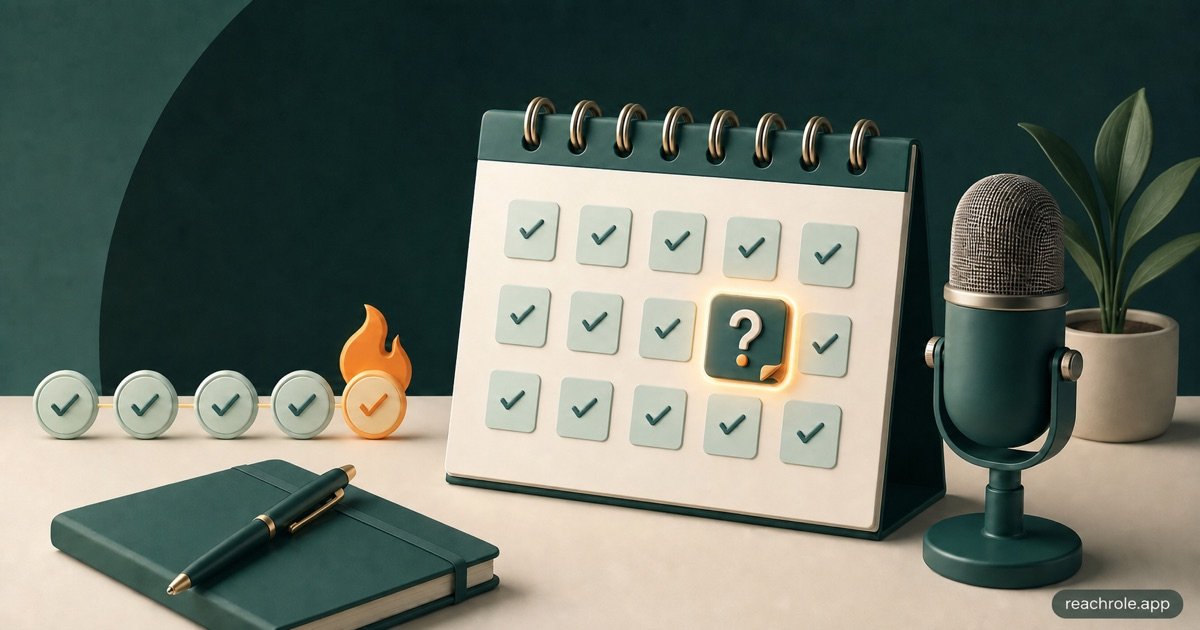
A visible streak provides a simple cue to return tomorrow. It reduces the daily decision from “Should I prepare for interviews?” to “What is today’s question?” That is the useful idea behind an interview prep streak app: remove friction, make progress visible, and keep the practice small enough to repeat. The streak should support learning, not become a number you protect at any cost.
If you miss a day, continue the next day. Consistency across several weeks matters more than a perfect record. Keep the session small enough to complete even during a busy job search.
- Set a fixed trigger, such as after breakfast or before opening job boards.
- Keep the minimum session short: one question is enough.
- Track weak question types and revisit them later in the week.
- Review your story bank before a real interview, not dozens of new questions.
Start a daily interview practice streak in ReachRole
ReachRole includes interview questions across multiple professions, model answers, coaching tips, and self-ratings such as Strong, Needs work, and Off-track. You can also generate questions from a specific job description when you need role-focused preparation.
Use the daily question to build the habit before an interview is booked. When an opportunity arrives, you will already have practiced retrieving your strongest examples instead of trying to create them the night before.
Check your resume against these hiring standards
Upload your PDF to get an instant match score, detect missing keywords for your target role, and check single-column parsing.
Scan my resume free → ✓ No account needed · Takes 60 seconds
Shivani S Co-founder, ReachRole
Co-founder of ReachRole. Writes about ATS screening, resume structure, and the Indian hiring process.