Off-Campus Job Search for Freshers in India.
A practical off-campus job search guide for Indian freshers: where to apply, how to get referrals, and how to run the process without losing track.
 By Shivani S, Co-founder, ReachRole
What is the most effective off-campus job search strategy for Indian freshers?
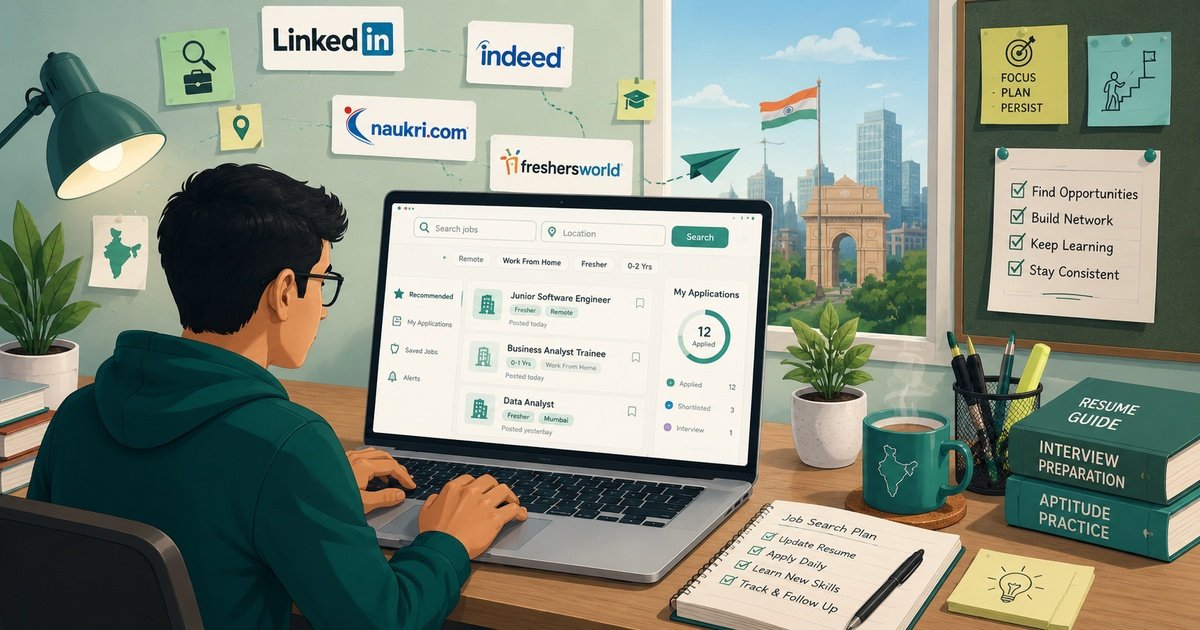
The most successful off-campus strategy combines applying on company career pages within 48 hours of posting, cold emailing founders and engineering leads with live demo links, and securing employee referrals on LinkedIn. Avoid mass-applying on public portals; instead, submit 3–5 deeply tailored applications daily backed by verifiable proof of work.
Most fresher advice assumes campus placement. Plenty of students never get that route — the college has weak placement, the eligibility cutoff excluded them, the branch was not called, or they graduated and the window closed.
Off-campus hiring is a genuinely different process. It is slower, more competitive per application, and nobody organises it for you. It also has no CGPA gate, no single-offer rule, and no restriction on which companies you approach. Here is how to run it properly.
Where the jobs actually are
Company career pages. The least crowded channel and the most overlooked. If you have twenty target companies, check their career pages weekly. Many roles are posted there days before they reach job boards, and some never leave.
LinkedIn. Filter to entry level and sort by most recent. The important part is applying within roughly 48 hours of posting — fresher listings can draw hundreds of applications in the first days, and later ones are often never opened.
Naukri. Still the highest-volume board in India. Keep your profile updated, because a lot of recruiter activity here is search-driven rather than application-driven — they find you rather than the reverse.
Internshala. Worth it for internships and fresher roles, particularly at smaller companies.
Company Discord, Slack, and Telegram groups. Underrated. Many startups post openings to their community before anywhere else.
AngelList / Wellfound. For startups, where fresher hiring tends to weigh projects more heavily than pedigree.
Referrals matter more than volume
A referred application gets looked at. A cold one may not. This is the single biggest difference between candidates who get interviews and candidates who send hundreds of applications into silence.
You do not need to know anyone senior. The people most likely to refer you are one or two years ahead — recent graduates from your college who joined the company you are targeting. Search LinkedIn for your college name plus the company name.
When you message them, be specific and brief:
Hi [name] — I am a 2026 CSE graduate from [college]. I saw you joined [company] last year. I have applied for the [exact role] and wanted to ask whether you would be open to referring me. I have attached my resume. Happy to share more about the projects if useful.
That works because it names the role, shows you already applied, and asks one clear question. What does not work is "please refer me anywhere" with no role and no resume.
Expect most messages to go unanswered. That is normal and not about you — send more.
Apply narrow, not wide
The instinct is to apply everywhere. It performs badly.
Twenty applications with a resume tailored to each role beat two hundred identical ones. Tailoring does not mean rewriting from scratch — it means reading the job description, and making sure the skills it names actually appear in your resume where you genuinely have them.
If a posting asks for React, Node, and PostgreSQL, those three words should be findable in your skills and project bullets. If they are not, the screening filter may drop you before a human reads anything.
Track everything
By week three you will not remember which version of your resume went to which company, or that you applied twice to the same role.
Keep a record of company, role, date applied, resume version used, referral status, and outcome. A spreadsheet is fine. ReachRole has an application tracker if you would rather not maintain one.
The reason this matters beyond tidiness: after thirty applications, the record is data. If you are getting no callbacks at all, the problem is the resume. If you get callbacks but no interviews, it is the screening round. If you reach interviews and stop there, the resume is working and the preparation needs attention. Without a record you cannot tell these apart, and you will fix the wrong thing.
The timeline is longer than you expect
Off-campus searches commonly run two to four months from first application to offer. Individual processes take three to six weeks — application, screening, one or two technical rounds, HR round, offer.
Knowing this in advance matters, because the most common failure mode is not lack of ability. It is deciding after three silent weeks that it is not working, and stopping.
Before you start applying
Run your resume through a free ReachRole scan first. Fixing it after fifty applications means fifty wasted applications — most companies will not reconsider you for the same role, and you cannot re-apply your way out of a bad first impression. Check it once, fix what it flags, then start.
Check your resume against these hiring standards
Upload your PDF to get an instant match score, detect missing keywords for your target role, and check single-column parsing.
Scan my resume free → ✓ No account needed · Takes 60 seconds
Shivani S Co-founder, ReachRole
Co-founder of ReachRole. Writes about ATS screening, resume structure, and the Indian hiring process.