How to Add AI Skills to Your Resume.
Learn how to add AI skills to your resume without sounding fake, including examples for software, product, marketing, sales, operations, and fresher resumes.
 By Shivani S, Co-founder, ReachRole
Adding AI skills to your resume in 2026 is no longer only for machine learning engineers. Employers in India now expect software engineers, product managers, marketers, analysts, sales teams, operations teams, and freshers to understand how AI changes everyday work. The mistake most candidates make is adding a vague line like "familiar with AI tools" without proof. That does not help with recruiters, ATS searches, or interviews.
How should software engineers and tech professionals list AI skills on their resume?
Avoid listing generic buzzwords like "Prompt Engineering" or "ChatGPT" in isolation. Instead, integrate AI competencies into your Technical Skills section (e.g., LLMs, LangChain, RAG architectures, OpenAI API, Hugging Face) and demonstrate their impact in your experience bullet points by quantifying business outcomes (e.g., "Built automated semantic search pipeline using vector embeddings, reducing customer support query resolution time by 42%").
This guide shows how to add AI skills honestly and usefully: where to place them, which keywords to use, how to connect them to outcomes, and how to avoid sounding like you copied a trend. The goal is not to pretend you are an AI specialist. The goal is to show that you can use AI responsibly to improve speed, quality, analysis, automation, or decision-making in your actual role.
Use this guide well
Add only AI skills and workflows you can explain with a real example, a review step, and an honest outcome.
The AI skills employers want to see
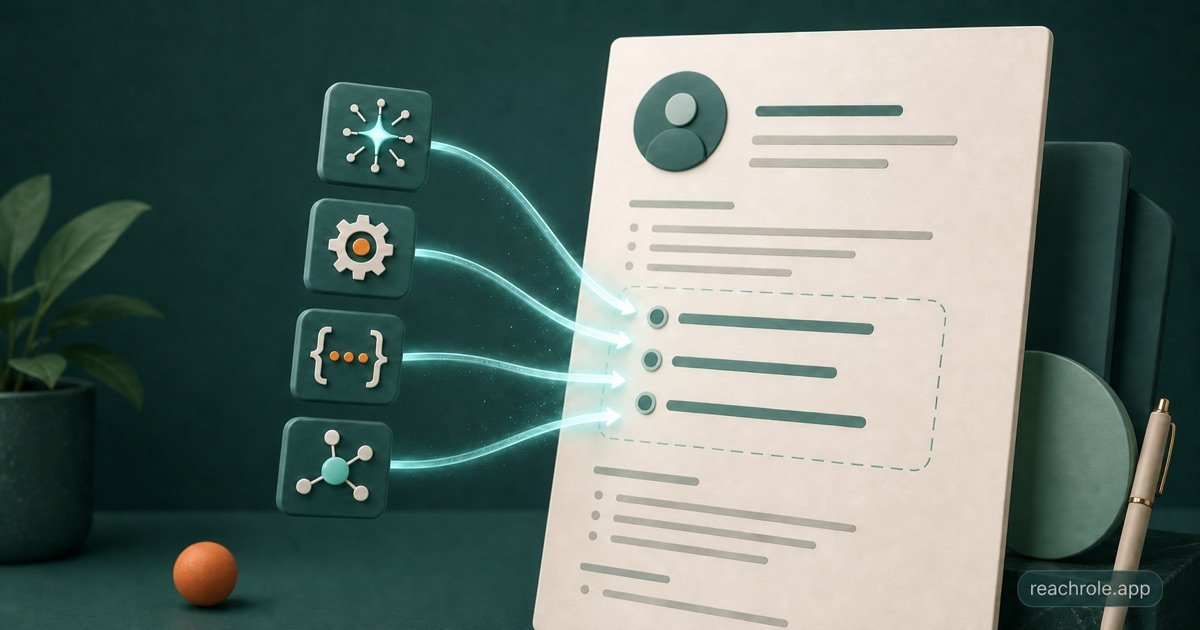
Start with the kind of AI skill that matches your job. For software roles, useful terms include LLMs, prompt engineering, RAG, vector databases, embeddings, AI-assisted coding, evaluation, automation, API integration, and responsible AI. For product roles, use AI product discovery, user workflows, model limitations, experimentation, AI feature adoption, and human-in-the-loop review. For marketing and sales, mention AI content workflows, campaign personalization, lead scoring, CRM automation, audience research, and quality control.
For analysts and operations teams, stronger keywords include workflow automation, data cleaning, dashboard summarization, anomaly detection, forecasting, document processing, and AI-assisted reporting. Freshers can include AI projects, coursework, hackathons, prompt workflows, GitHub demos, or practical experiments. The important point is proof. A keyword in Skills helps ATS matching, but a bullet in Experience or Projects proves you used it.
Avoid claiming "AI expert" unless your work truly includes model development, deployment, evaluation, or research. A better line is specific: "Used LLM-assisted research workflows to reduce weekly market scan time by 40%" or "Built a resume feedback prototype using embeddings and semantic keyword matching." These bullets give recruiters something concrete to trust.
What this means for your job search
If two candidates have similar experience, the one who can show AI awareness often looks more current. This does not mean every job becomes an AI job. It means employers want people who can adapt tools, question outputs, protect data, and improve productivity without lowering quality. Your resume should show that you understand where AI helps and where human judgment still matters.
Place AI skills in three areas: a Skills section for searchability, project or experience bullets for proof, and interview stories for credibility. If you only add AI to Skills, it looks thin. If you only mention it in one project, ATS tools may miss it. Use both.
Practical action steps
First, scan your resume for vague AI language. Replace "used AI tools" with the exact workflow, tool category, and result. Second, add one AI-aware bullet under your strongest recent role or project. Third, add only the keywords you can explain in an interview. Fourth, prepare one story about using AI responsibly, including how you checked quality or protected sensitive information.
Good resume bullets sound like this: "Created an AI-assisted customer research workflow that summarized 120 support tickets and identified three onboarding issues for the product team." Or: "Used prompt templates and manual QA to speed up weekly campaign reporting while keeping final recommendations human-reviewed." These are believable because they connect AI to work, not hype.
Check your resume against these hiring standards
Upload your PDF to get an instant match score, detect missing keywords for your target role, and check single-column parsing.
Scan my resume free → ✓ No account needed · Takes 60 seconds
Shivani S Co-founder, ReachRole
Co-founder of ReachRole. Writes about ATS screening, resume structure, and the Indian hiring process.