How to Write a Career Change Resume in 2026.
A step-by-step guide to writing a career change resume in India, with advice on transferable skills, resume format, summary, and ATS keywords for career switchers.
 By Shivani S, Co-founder, ReachRole

Writing a career change resume is not about hiding your past. It is about reframing your past so a recruiter in your target industry can see the relevant skills, outcomes, and judgment you already have. The biggest mistake career switchers make is sending a resume that reads like a job history from the old role. The second biggest mistake is removing all previous experience and looking like a fresher with years of unexplained time.
In India in 2026, career changes are more common than ever. Developers move into product management. Teachers move into corporate training and L&D. Sales professionals move into customer success. Marketers move into growth or analytics. The path is real, but the resume needs to make the bridge visible. This guide shows you how.
How do you write a career change resume in India?
Use a hybrid resume format featuring a clear 2-line summary that declares your target role, highlights your strongest transferable capability, and provides one measurable proof point. Rewrite past experience bullets using the target role's keywords and vocabulary—quantifying outcomes like team scale, process efficiency, or cost reduction—instead of erasing previous employment history.
Use this guide well
Apply the recommendations to one real target role at a time, then keep only the changes you can support in an interview.
Start with a summary that declares the pivot
Your resume summary is the most important section in a career change resume. It must do three things in two or three lines: state the role you are targeting, connect your strongest transferable skill to that role, and give one piece of proof. A summary like "Operations manager with 6 years of process optimisation experience, transitioning to product management with a focus on internal tools and workflow automation" immediately tells the recruiter what you want and why your background is relevant.
Do not use a generic objective like "seeking challenging opportunities." That wastes the most valuable real estate on the page. The summary should make a recruiter think "this person is not a perfect match but I can see why they applied" rather than "this resume was sent to the wrong job."
Reorder and rewrite your experience for the target role
You do not need to delete your previous roles. You need to rewrite the bullets to emphasise the parts of each role that transfer. A teacher who managed a classroom of 40 students, created curriculum, tracked learning outcomes, and handled parent communication has skills that transfer directly to training, content, project coordination, or stakeholder management roles.
For each role, ask: what did I do here that the target employer would value? Lead with those bullets. Push role-specific tasks that do not transfer to the bottom or remove them. If you managed budgets, led a team, improved a process, handled data, built reports, or worked cross-functionally, those are transferable regardless of industry.
- Rewrite bullet points to use the language of the target role.
- Lead with transferable achievements, not job-specific duties.
- Quantify outcomes wherever possible: team size, process improvement, cost savings, time saved.
- Add a Skills section that includes keywords from target job descriptions.
- Include any bridge experience: freelance projects, certifications, courses, or volunteer work in the target domain.
Choose the right resume format for a career change
A hybrid resume works best for most career changers. Start with a summary, follow with a Skills or Core Competencies section, then list your experience in reverse chronological order with rewritten bullets. This format gives ATS tools the chronological structure they expect while letting you lead with relevant skills.
Avoid a purely functional resume that groups skills without tying them to specific roles and dates. Most Indian recruiters and ATS tools expect to see where and when you worked. A resume that hides dates or employer names creates suspicion rather than solving the career-change problem.
Common career change paths and what to highlight
Developer to product manager: highlight user research, feature scoping, sprint planning, stakeholder communication, data-driven decisions, and shipped products. Teacher to L&D or corporate training: highlight curriculum design, assessment, facilitation, content creation, feedback loops, and learner outcomes. Sales to customer success: highlight relationship management, retention, upselling, onboarding, CRM usage, and revenue impact.
Marketing to growth or analytics: highlight campaign measurement, A/B testing, funnel analysis, SQL or dashboard work, attribution, and ROI reporting. Operations to project management: highlight process improvement, cross-functional coordination, vendor management, budget ownership, and delivery timelines. In every case, the key is translating the old title into the new role's vocabulary.
Tailor your career change resume with ReachRole
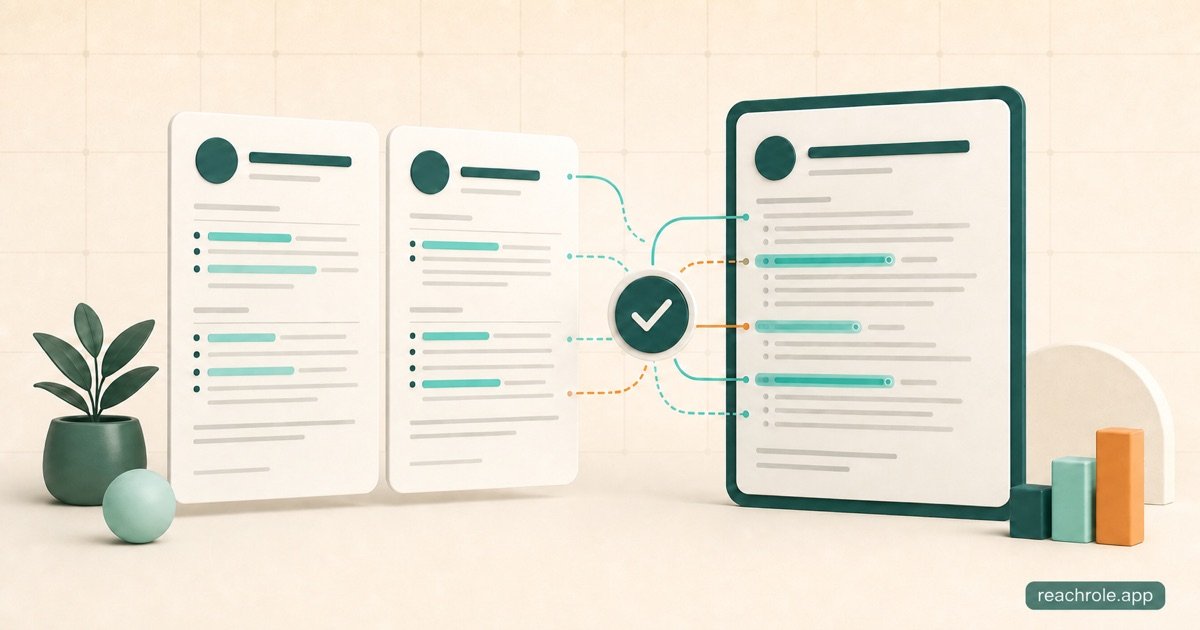
ReachRole lets you compare your resume against the job description of the role you want to switch into. It shows which keywords you are missing and which bullets need strengthening. This is especially useful for career changers because the keyword gap between your old role and your target role is usually the biggest barrier to getting past ATS filters.
Check your resume against these hiring standards
Upload your PDF to get an instant match score, detect missing keywords for your target role, and check single-column parsing.
Scan my resume free → ✓ No account needed · Takes 60 seconds
Shivani S Co-founder, ReachRole
Co-founder of ReachRole. Writes about ATS screening, resume structure, and the Indian hiring process.