How Much ATS Score Is Required to Get Shortlisted?.
The real ATS score you need to get shortlisted in India, why there is no single universal number, and the exact fixes that move your score up fast.
 By Shivani S, Co-founder, ReachRole

What is the minimum ATS score required to get shortlisted?
There is no universal minimum ATS score that guarantees a shortlist. For a job-description match checker, 75% or higher is a practical revision target, but it is a directional score—not a certified pass mark. Employers configure their own screening rules, and many never expose an ATS score to candidates.
You have applied to 150 jobs. Maybe more. Your resume looks fine to you — clean, honest, decent projects. And still: silence. No rejection email, no callback, nothing. So you start asking the question every job seeker eventually asks: how much ATS score is required to get shortlisted?
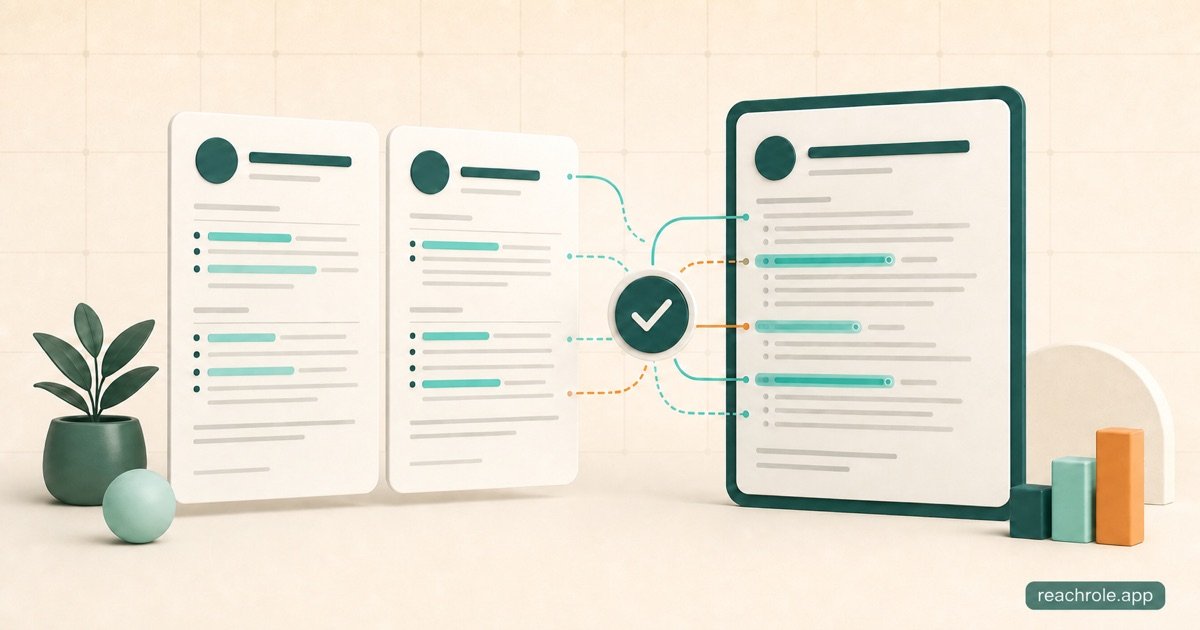
If you want one number to guide revisions, aim for 75–85% against the specific job description in the same checker. A lower score flags possible parsing or relevance gaps; it does not prove that an employer rejected you. Chasing 100% is counterproductive because copied or stuffed keywords hurt credibility when a recruiter reads the resume.
This is exactly the gap ReachRole was built to close. Upload your resume next to a real job description, get a directional match score in seconds, and see which relevant keywords may be missing — free, with no account needed for the first check. Before you send application number 151, it is worth knowing what to improve.
Why there is no single universal ATS score
This is the part almost nobody explains properly. "ATS score" is not one thing. It is a rough label for several different systems that all behave differently:
- Company-configured ATS tools (like the ones TCS, Infosys, Amazon, or a mid-size startup use internally) score your resume against that specific job requisition — the weighting is set by whoever configured the tool, and it is different at every company.
- Platform profile scores (like your Naukri profile completeness meter) measure how filled-out your profile is, not how well you match a particular job.
- Keyword-match tools (like ReachRole or Jobscan) simulate the matching logic most ATS software uses, so you get a directional score you can actually act on before you apply.
None of these three is "the" ATS score. So when someone tells you "you need 85% to get shortlisted," they are usually talking about the third kind — a simulated match score against one specific job description. That is also the only kind of score you can actually control. You cannot see or influence a company's internal ATS configuration. You can control how well your resume mirrors the job description in front of you.
How ATS scoring actually plays out on Indian platforms and companies
The logic changes depending on where you are applying. Knowing which game you are playing changes what you should optimize for.
- Naukri: Recruiters search Naukri's database using keywords tied to the role — skills, designation, location, experience band. If your profile and resume do not contain the exact terms a recruiter searches for, you will not show up in results at all, regardless of how good you are. This is a search-ranking problem before it is a "score" problem.
- LinkedIn: Easy Apply and recruiter search both lean heavily on your headline, About section, and Skills list matching the job's listed skills. A resume that is strong but a LinkedIn profile that is thin will still under-perform.
- Service companies (TCS, Infosys, Wipro, Accenture and similar): These run enormous applicant volumes through keyword-heavy ATS filters first, because the recruiter cannot manually read tens of thousands of resumes. Exact-phrase matching matters more here than almost anywhere else — if the job notification says "problem solving" and "SQL," your resume needs those exact words, not close synonyms.
- Product companies and startups: ATS filtering still happens, but the bar is often lower on keyword density and higher on proof — a recruiter or hiring manager reads shortlisted resumes personally, so once you clear the initial filter, vague bullets and unproven claims cost you here instead.
The practical takeaway: a services-company application and a startup application should not use the identical resume. The keyword strategy is different because the reader on the other end is different.
Check this resume against your target job
Upload your resume and paste the job description. See your directional match score, parsing issues, and missing keywords you can honestly support.
Run the free ATS check →No credit card. No signup required for your first scan.What actually pulls your score down (and how to fix each one)
Most low scores come from a short, repeatable list of causes. Work through these in order:
- Formatting the software cannot parse. Tables, text boxes, two-column layouts, icons used as labels, and headers holding your contact details are the single biggest cause of a resume scoring near-zero for reasons that have nothing to do with your experience. Fix: single column, standard section headings, save as a text-selectable PDF.
- Missing exact keywords. "Built REST APIs" does not match a job description asking for "API development" as well as you'd think, and "worked with databases" does not match "PostgreSQL" at all. Fix: mirror the job description's exact phrasing wherever it is honestly true for you.
- Vague, duty-based bullets. "Responsible for backend development" tells an ATS almost nothing and tells a recruiter even less. Fix: rewrite as outcome + tool + number — "Built Node.js APIs for payment reconciliation, reducing manual checks by 30%."
- Keyword stuffing. Cramming in every tool you have ever touched — or repeating one term unnaturally — reads as generic to a recruiter and does not help as much as candidates hope, because modern matching weighs relevance and context, not raw frequency. Fix: fewer, proven, defensible skills beat a long undifferentiated list.
- One resume for every application. The resume that works for a services-company keyword filter is not the resume that reads best to a startup hiring manager. Fix: tailor the top third of your resume — headline, summary, skills order — per application. You do not need to rewrite the whole document each time.
The 10-minute fix routine before you hit submit
- Copy your resume text into a plain editor. If sections scramble, headings vanish, or bullets merge — that is your first fix.
- Paste the job description next to your resume and highlight every hard skill, tool, and role keyword mentioned.
- Check each highlighted term against your resume. Anything missing that is honestly true for you — add it, in context, inside a bullet.
- Read your top three bullets out loud. If any of them describe a duty instead of a result, rewrite it with a number.
- Re-check your score. If you are above 75% against this specific job, you are in a competitive range. Send it.
What each score band actually means
Scores are only useful if you know what to do at each level. Against one specific job description:
| Match score | What it means | What to do |
|---|---|---|
| Below 60% | Large parsing or relevance gap in this checker | Fix formatting first, then add missing hard skills that are honestly true for you |
| 60-74% | Borderline. Sometimes seen, often not | Mirror the exact phrasing in the job description and rewrite duty-based bullets |
| 75-85% | Competitive. This is the target | Send it. Further tuning has poor returns |
| Above 90% | Usually a warning sign | Check you have not stuffed keywords or copied the advertisement back at them |
That last row surprises people. A very high score against a job description often means the resume has been written to match the text rather than to describe your work, and a recruiter notices that faster than software does.
A higher score does not mean a better chance
Past roughly 85%, more matching stops helping. The filter has already been cleared, and everything after that is a human deciding whether they believe you.
This is the trap in optimising for the number. A resume at 95% built by pasting in every term from the advertisement will clear the filter and then fail the interview, because none of it survives a follow-up question. A resume at 78% with three defensible, quantified bullets will not.
Two things the score cannot see, which decide the outcome once you are past the filter: whether your bullets describe results or duties, and whether you can talk for ten minutes about anything you claimed. Neither is measurable by keyword matching, and both matter more than the last ten percentage points.
Common questions
What is the minimum ATS score required to get shortlisted? There is no certified minimum, because every company configures its own screening process. As a working revision target, aim for at least 75% against the specific job description in the same checker. A lower score signals gaps to investigate; it does not prove an employer rejected you.
Is a 60% ATS score good enough? Usually not. It normally means several hard skills named in the job description are missing from your resume, or your formatting is not parsing cleanly. Both are fixable in a single sitting.
Should I aim for 100%? No. A perfect match generally means the advertisement has been copied back, which reads as generic to the recruiter who picks it up next. The 75-85% range is where you want to be.
Does the required score change by company? Yes, and significantly. High-volume services-company hiring leans harder on exact keyword matching than product companies and startups, where a person reads shortlisted resumes and weighs proof instead.
Does ATS score matter for freshers? It matters more, not less. Fresher applications arrive in the largest volumes, so the mechanical filter does more of the work before anyone reads anything. Your projects section is what carries the keywords.
Can I check my ATS score for free? Yes. Upload your resume with the job description on ReachRole and you get a match score and the missing keywords without an account for the first check.
So — how much ATS score do you actually need?
If you need one number to anchor on: aim for 75–85% match against the specific job description you are applying to. Treat that as a revision range within the same checker, not a universal hiring threshold. There is no certified passing score, no universal 100%, and no tool — including ReachRole — that can promise a shortlist. A useful match score tells you what to inspect before applying; the employer still decides what advances.
You do not need to guess anymore. You do not need to keep sending the same resume 150 more times and hoping. Upload it once, check it against the job in front of you, fix what is actually broken, and apply knowing you gave it a real shot.
Know what to fix before your next application
Upload your resume with the target job description to see a directional match score, missing keywords, and prioritized fixes.
Check my resume free →Your first scan needs no signup. Built for Indian job seekers applying on Naukri, LinkedIn, and off-campus drives.Check your resume against these hiring standards
Upload your PDF to get an instant match score, detect missing keywords for your target role, and check single-column parsing.
Scan my resume free → ✓ No account needed · Takes 60 seconds
Shivani S Co-founder, ReachRole
Co-founder of ReachRole. Writes about ATS screening, resume structure, and the Indian hiring process.